Predictable Torque in D1 Hard Bone: Same-Day #36 Re-placement Using ALX-BT

Case Summary 🔎
Patient Information
55 y/o, Male
Past Medical History: Gout (on medication)
Diagnosis : Peri-implantitis around #36 implant
Treatment Plan : Same-day fixture removal and immediate placement of
ALX-BT 6008
Introduction
Peri-implantitis has become a major challenge in implant dentistry, frequently necessitating fixture removal. While immediate, same-day re-placement offers significant advantages in reducing overall treatment time, performing this procedure in D1 dense cortical bone presents severe clinical hurdles, such as the risk of over-torque and subsequent bone necrosis. This case presentation demonstrates a successful management of a failing #36 implant due to peri-implantitis. By utilizing the ALX-BT 6008 system, we achieved ideal primary stability and controlled insertion torque during immediate re-placement, offering a predictable clinical protocol for challenging high-bone-density sites
Case Presentation
1️⃣ Pre operative
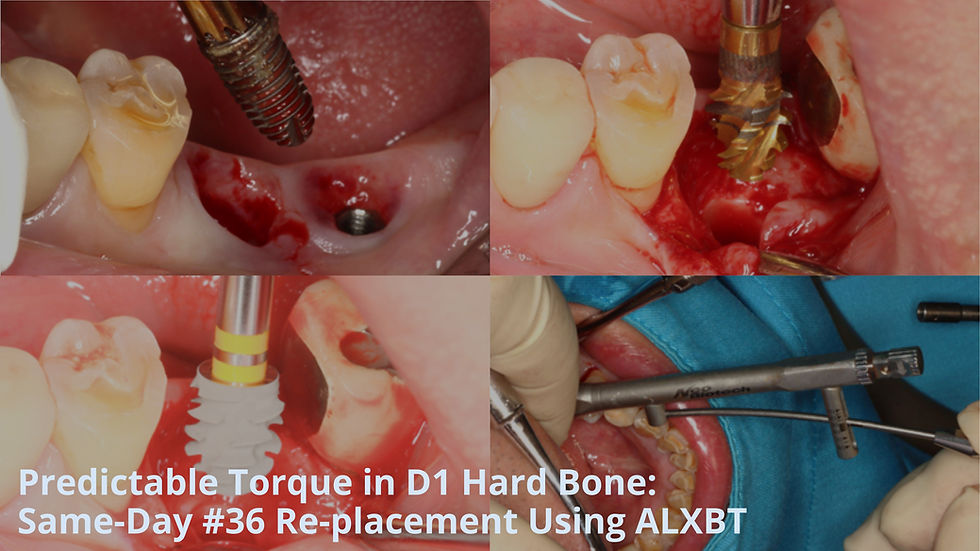
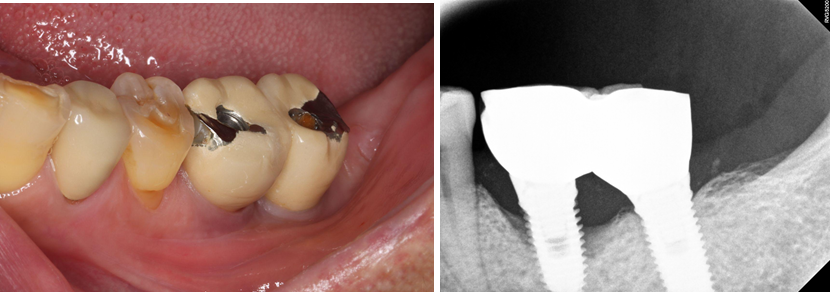
Significant gingival swelling, inflammation, and clear peri-implant bone loss were observed around #36.
Based on this advanced failure, a clinical decision was made to proceed with fixture removal.

2️⃣Fixture removal
The failing #36 fixture was cleanly and successfully retrieved using a specialized Fixture Removal (FR) kit.
Despite coronal bone resorption, the intact apical bone structure provided sufficient anchorage to allow for immediate re-placement.

3️⃣Surgery
Sequential drilling from Ø2.2 to Ø4.5 was completed, followed by Ø5.0 cortical drilling., to maximize bone preservation, a MAXY 6.0 pre-tap
The pre-tapping process precisely formed clean internal threads within the dense D011 apical bone structure.


The ALX-BT 6008 fixture achieved an ideal insertion torque of 40 N·cm within the dense D011 bone, safely avoiding over-torque risks.
Excellent primary stability was quantitatively confirmed with an outstanding IST value of 85.


The peri-implant defect resulting from coronal bone resorption was filled with a mixture of Neo Bone(FDBA) and DM Bone(alloplast) graft materials.
A CollaGuide resorbable collagen membrane was adapted over the grafted site for guided bone regeneration (GBR).

A cross-suture was precisely placed over the healing component to achieve stable soft tissue adaptation and securely contain the underlying GBR materials.
Post-operative radiograph


An impression was successfully taken at just 3 weeks post-operatively due to the excellent initial stability and rapid early tissue healing.
The final prosthesis is scheduled for completion within 4 weeks, achieving an ultra-rapid loading protocol for this immediate re-placement case.


Comments