8-year long term clinical stability of IS-III implants in the mandibular posterior area


Case Summary 🔎
Patient Information
•Age/Gender: 60-year-old, Female
•Past Medical History: No systemic disease reported
•Drug allergy: None
•Chief complaint: "I have the missing teeth on the lower area."
Introduction
Long-term clinical data are essential for evaluating the predictability and stability of dental implant systems. Especially in the mandibular posterior region, high occlusal forces require implants to maintain stable osseointegration and marginal bone levels over time.
This case presents an 8-year long-term follow-up of two IS-III implants placed in the mandibular right posterior region (#46 and #47). At the time of surgery, the ridge showed favorable healing without severe bone loss, allowing for straightforward implant placement with adequate primary stability. Cortical tapping was performed to optimize insertion torque and implant positioning in dense bone.
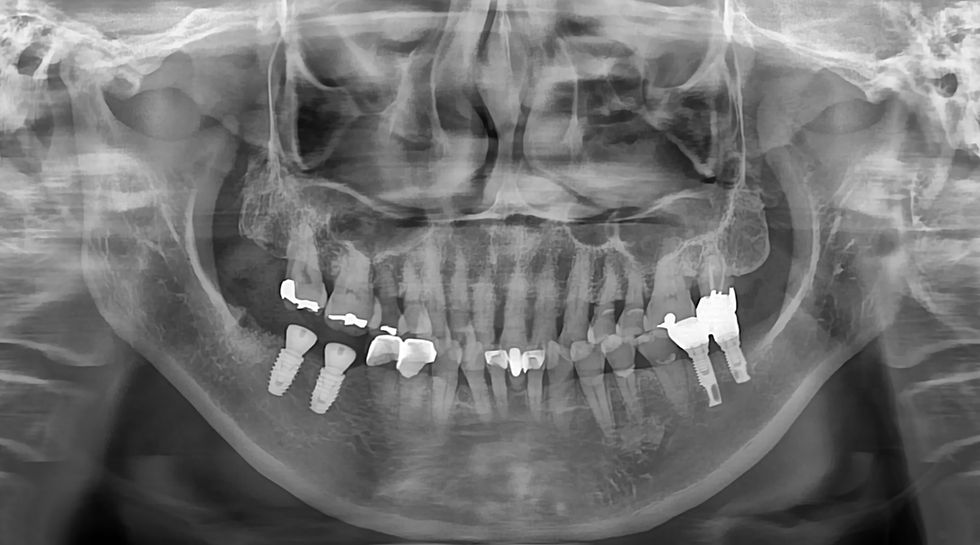
Annual radiographic follow-ups were conducted from 2016 to 2024. The most recent panoramic radiograph confirms stable peri-implant bone levels without signs of pathological bone loss, demonstrating the long-term reliability of the IS-III implant system.
Treatment Plan
Extraction of #48 and full-thickness flap elevation at #46 and #47
Osteotomy preparation with cortical tap due to dense cortical bone
Placement of IS-III implants at #46 and #47 (IS35008) with sufficient primary stability
Connection of healing abutments and non-submerged healing
Fabrication and delivery of zirconia final prostheses after healing
Annual clinical and radiographic follow-up, including panoramic radiographs up to 2024
Case Presentation
1️⃣ Pre-Op
Both panorama and intra-oral picture shows a well-healed alveolar ridge without severe bone loss, providing favorable foundation for implant placement.
2️⃣ Surgery / Final Restoration
#48 was extracted, and a full-thickness flap was elevated extending to the #46 and #47 regions to allow adequate visualization.
Flap elevation to create adequate space for IS-III implant placement.
A cortical tap was used to prepare the dense cortical bone, allowing smoother implant insertion and controlled engagement of the IS-III fixture while reducing excessive insertion torque.
The crestal bone clearly demonstrated the implant thread configuration, indicating precise osteotomy preparation and optimal engagement of the IS-III implant.
IS-III implant was placed at site #46, achieving controlled insertion after cortical tap preparation.
Two IS35008 were placed at #46 and #47. Both sites demonstrated D133, achieving good primary stability with an insertion torque of 40N/cm.
Panoramic radiograph taken after placement of IS-III implants at #46 and #47. Both implants are well positioned with an ideal angulation and parallelism, demonstrating accurate placement.
The final prosthesis was seated on the working model prior to actual delivery to the patient.
The final zirconia prosthesis was delivered intraorally, showing stable seating, proper occlusal morphology.
3️⃣ Annual follow-up


Annual follow-up was performed through 2024, and the most recent panoramic radiograph confirms stable peri-implant bone levels with no evident bone loss, indicating successful long-term maintenance over the 8-year follow-up period.
Conclusion
This case demonstrates the long-term clinical stability of IS-III implants placed in the mandibular posterior region over an 8-year follow-up period. Both implants achieved high primary stability at the time of placement and maintained stable peri-implant bone levels without signs of pathological bone loss through annual radiographic evaluation.
The use of cortical tapping contributed to controlled insertion in dense bone, ensuring optimal implant positioning and long-term osseointegration. The favorable clinical and radiographic outcomes observed up to 2024 highlight the predictability and durability of the IS-III implant system under functional loading.
This case supports the reliability of IS-III implants as a long-term solution for posterior mandibular rehabilitation when appropriate surgical planning and maintenance protocols are applied.

![[ENG] Reality of Sinus Lateral Bone Graft Procedure by SLA kit](https://static.wixstatic.com/media/5642c3_a2fa917d99c14f32862dade9452bc1e0~mv2.png/v1/fill/w_980,h_552,al_c,q_90,usm_0.66_1.00_0.01,enc_avif,quality_auto/5642c3_a2fa917d99c14f32862dade9452bc1e0~mv2.png)

Comments